
What Actually Happens in Marriage Coaching
A step-by-step walkthrough for the couple sitting in the driveway with the booking page open, not clicking.
We know that couple.
Engine off. Groceries melting in the back. One of them has our page pulled up on a phone, thumb hovering, and neither one is saying anything, because saying something out loud makes it real.
Here's what's usually underneath the hesitation: it isn't that you don't want help. It's that you have no idea what you'd be walking into, and the unknown feels worse than the stuck.
So let's take the mystery out of it. Start to finish, here's what this actually looks like.
Step one: the discovery call
It's free, it's about thirty minutes, and it's both of you.
We'll ask what's going on, what you've already tried, and what you'd want to be different six months from now. We handle the assessment piece right here too, so you're not filling out paperwork for a week before anybody talks to you. Before we start giving advice, we want data instead of opinions — including ours.
Almost every couple has the same reaction to hearing their marriage described back to them plainly: relief. Not because it's flattering, but because something they've been arguing about vaguely for three years finally has a name and a shape. It is not a grade. Nobody gets a score they have to show their mother.
You'll ask us whatever you want, too. This is not a sales call with a marriage-shaped bow on it — plenty of these calls end with us pointing a couple somewhere else, and that's a good outcome. You're interviewing us. You should be. You're about to tell two people some of the truest things about your life, and you ought to like them first.
Step two: an actual session
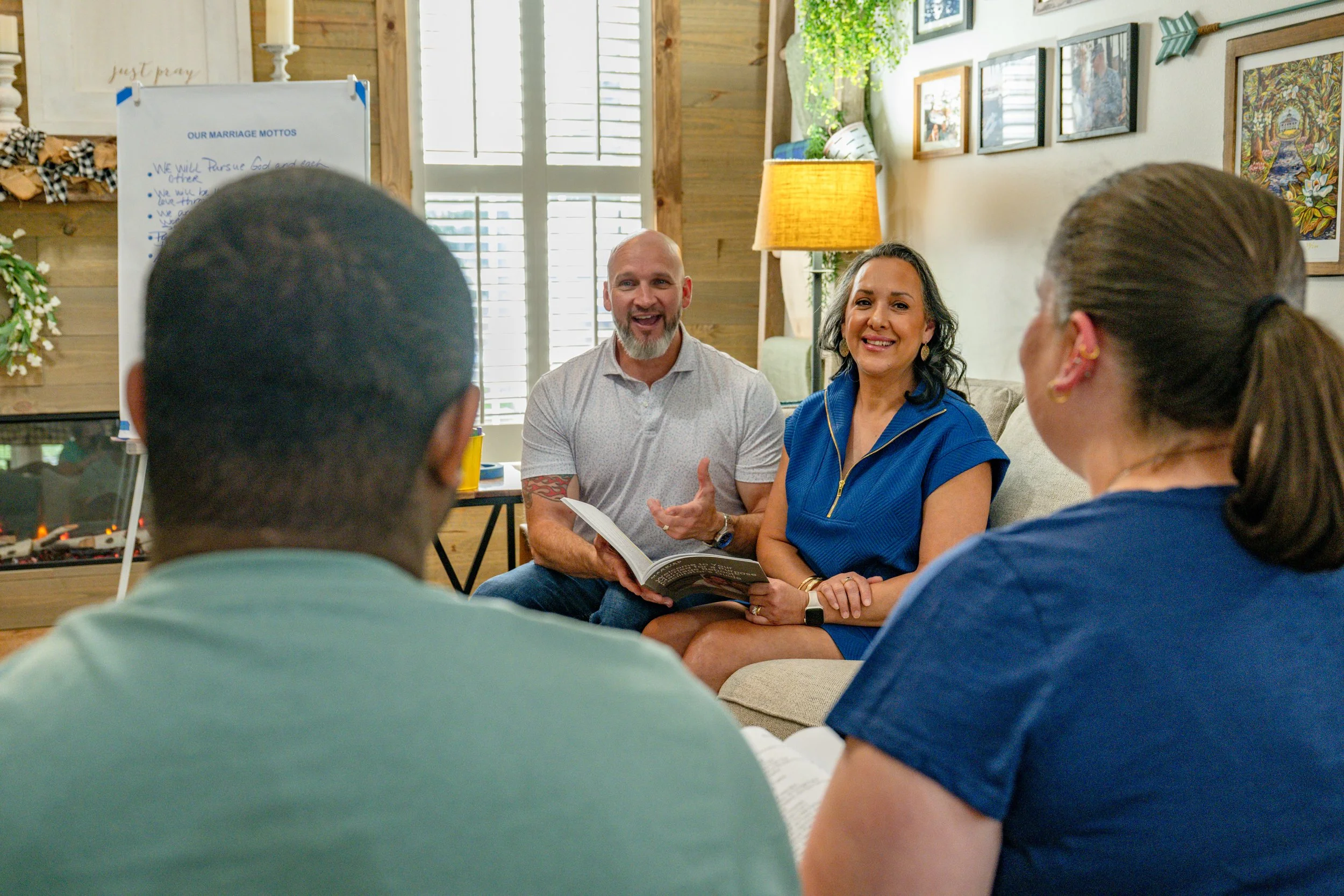
Sessions run about an hour, and they have a rhythm.
We start with a check-in — what happened since last time, what worked, what fell apart. Then we work one topic. Not nine. One. Then you practice it, in the session, with us in the room, because knowing a communication tool and being able to use it while your heart rate is up are two entirely different skills.
You'll both talk. If one of you is a talker and one of you is a "hm," we account for that. Nate was a "hm" for about fifteen years, so we're familiar.
If somebody cries, we keep going. If somebody shuts down, we stop and find out what just happened, because the shutdown usually is the information.
Nobody is going to make you do a trust fall.
Step three: the weeks in between
This is the part that actually changes marriages, and it's the part nobody talks about in the sales pitch.
You'll leave with something small and specific to do. Not a workbook the size of a phone book — usually one conversation, one practice, one habit. Fifteen or twenty minutes.
Couples who do the in-between work move forward. Couples who only show up for the hour tend to have a very pleasant hour, every other week, for a long time.
How long does this take?
Most couples aren't with us forever, and that's the design. We're aiming for a specific set of changes, not a standing appointment.
"Done" doesn't mean perfect. It means you two have your own tools, you can have the hard conversation without us refereeing, and you know how to repair it when you blow it — because you will blow it. We still do.
What we won't do
Take sides. There's no winner here, and no trophy.
Assign blame, or let either of you assign it to the other in our presence.
Judge you or the circumstances you're in. Ever.
Keep you longer than you need us.
Pretend to be something we're not — if what you need is clinical care, we'll say so and help you find it. Sometimes couples do both, and that combination works beautifully.
"Wait — is this therapy?"
No, and that distinction matters enough that we're giving it its own post next week. The short version: therapy tends to ask what happened to us, and coaching tends to ask where are we going and what do we do Monday.
The thread
For years, the two of us didn't need better technique. We needed someone to sit across from us and say the thing we couldn't say to each other. We didn't have that for a long time, and it cost us more than it should have.
Looking back, we can see grace holding the marriage together through those years, quietly, while we thought we were doing it on stubbornness alone. Coaching is just one of the ways that thread becomes visible — a room where somebody says the honest thing out loud, and the two of you finally get to stop guessing.

Talk It Through
Before you decide anything, sit down together and answer these:
What's the one conversation we keep starting and never finish?
If nothing at all changed in the next twelve months, how would we feel about that?
What would each of us need in order to be fully honest in a room with two other people?
You don't have to be in crisis to make the call. And you don't have to have the words for what's wrong — that's part of what the first conversation is for.

ABOUT THE AUTHOR
Life, Leadership, Legacy & Marriage Coach · 30+ Years of Leadership Experience
Nate Parsons is a life, leadership, legacy, and marriage coach and mentor with over 30 years of leadership experience spanning military, ministry, business, and personal development. He and his wife Noemi are the founders of S3 Leadership Solutions and On-Fire Marriage, dedicated to helping people across every life stage discover and fulfill their God-given purpose.
